


Transistor Moment for Light: Why Quantonation Backed PINC
For most of the history of photonics, controlling light has meant working with materials that are, in an important sense, passive. Linear optical materials let light pass through, bend, or reflect, but they can’t easily interact with light to switch it, mix it, or convert it into a different frequency on demand. That limitation has kept photonics a step behind electronics, where the transistor provided a scalable nonlinear building block for controlling electrical signals, enabling the integrated circuits that built the modern digital world.
Nonlinear optical materials break that limitation. They allow light to interact with itself and with other signals, enabling frequency conversion, modulation, and the kind of active control that electronics has had for seventy years. The challenge has always been scale: nonlinear optical interactions are inherently weak, and harnessing them efficiently in compact, scalable photonic circuits has historically been difficult. PINC, a Caltech spinout building integrated nonlinear photonic chips and laser engines on thin-film lithium niobate (TFLN), is working to solve exactly that problem. Quantonation believes its platform could unlock a genuinely new category of photonic infrastructure for quantum technologies, optical sensing, and next-generation AI infrastructure.
Finding PINC before it was looking to be found
Quantonation’s sourcing tool first flagged PINC’s website. It was simply called “PINCtech” and had a bare-bones stealth landing page: a logo, a physical address, a generic email. Two details stood out to Raphael: the name, and the address in Pasadena, home to Caltech and a dense cluster of deep-tech spinouts. The company wasn’t raising, and the first round of cold outreach went unanswered. It took several attempts before the team connected with co-founder and CEO Farzaneh Afshinmanesh.
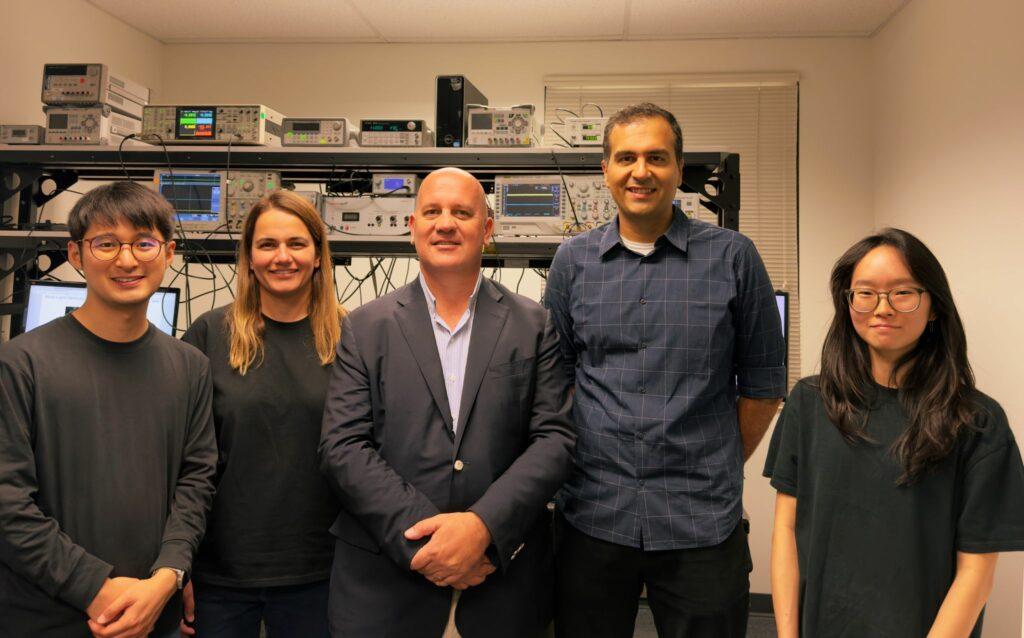
What followed were two or three calls. It wasn’t a typical pitch process, more an exploration of the technology and where it might lead. Farzaneh wasn’t actively raising. But in the course of those conversations, the Quantonation team learned that her co-founder, Caltech professor Alireza Marandi, was giving a scientific talk in London. Raphaël and Emily booked a 6:00 a.m. train out of Paris on short notice and pushed to get lunch with him. That meeting changed things. “That’s when we fell in love with the team and the tech,” said Raphaël Bodin. By his account, it was the moment Quantonation decided it wanted to lead. Days later, Alireza and Farzaneh opened the round and made space for them to do exactly that.
Building a partnership, not just a check
For Farzaneh, the relationship was built the same way: through curiosity that turned into trust. She points to meeting Raphaël early on: “His genuine curiosity about our technology, combined with his humility and positive attitude, left a lasting impression on us.” She also points to a later meeting between Raphaël, Emily, and Alireza in London that deepened the team’s confidence in the partnership. Meeting Christophe added another layer: “He immediately demonstrated a deep understanding of what it takes to build a successful deep-tech company from the ground up.”
By the time PINC closed its Seed+ round in summer 2025, both sides described it less as a transaction than the start of something longer. “As a deep-tech company developing a new class of integrated nonlinear photonic chips and laser engines, we knew from the beginning that we needed investors who understood that transformative technologies require both technical depth and patience,” said Farzaneh. “Quantonation immediately recognized not only the scientific foundation of our work, but also the long-term commercial opportunity that scalable integrated nonlinear photonics represents.”
Since the investment, that partnership has shown up in the day-to-day: offering strategic guidance and helping sharpen PINC’s thinking, and opening doors to customers, partners, and future investors across Quantonation’s network in the quantum technology ecosystem. “Their deep understanding of the quantum technology ecosystem has been invaluable as we have grown from a Caltech spinout into a company developing products for customers across quantum technologies, optical sensing, and next-generation AI infrastructure,” Farzaneh notes.
From lab demonstrations to commercial products
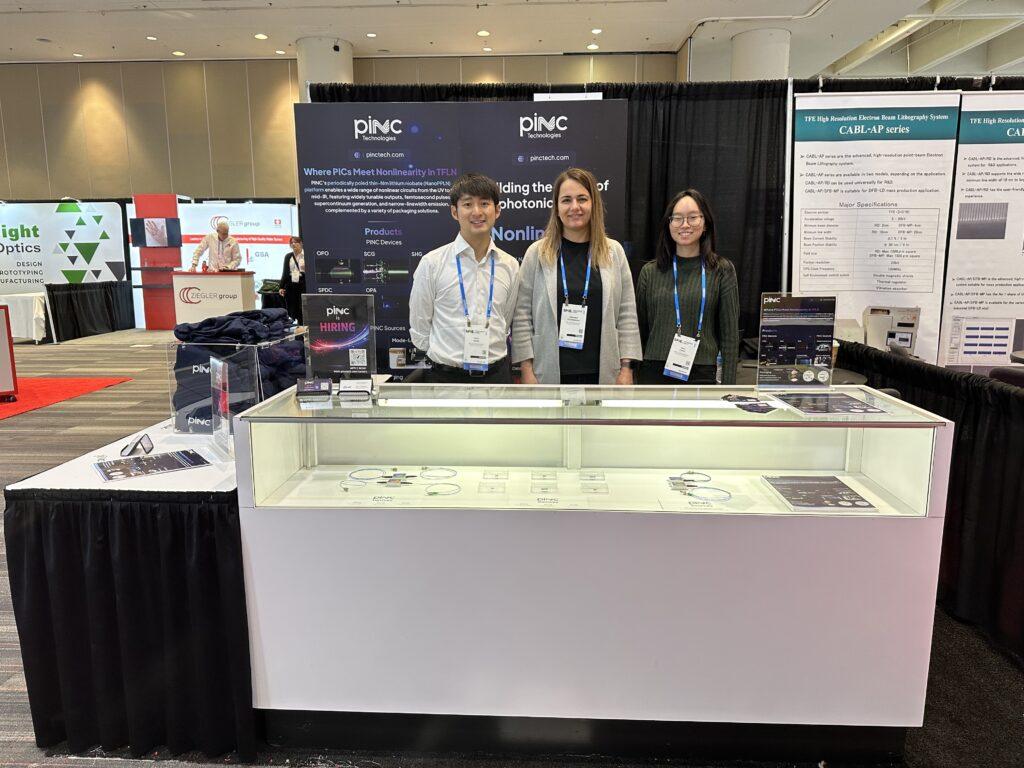
The progress since has been substantial. PINC has expanded its team, significantly built out its facility and in-house capabilities, advanced its technology from laboratory demonstrations toward commercial products, and established relationships with leading industrial customers. This has occurred all while working toward a broader vision: making advanced nonlinear photonics as accessible and scalable as today’s integrated electronics.
That’s the inflection point Farzaneh believes the field is approaching. Compact, scalable nonlinear photonic systems have the potential to change how coherent light sources (and the application-specific systems built around them) are developed, across quantum technologies, sensing, and AI infrastructure. PINC’s goal is to bring those capabilities into chip-scale platforms that cut size, cost, and complexity while pushing performance further.
“Having an investor with deep technical expertise, a long-term perspective, and a genuine commitment to helping founders succeed has allowed us to focus on solving challenging engineering problems while building a sustainable business,” Farzaneh says. “We look forward to continuing this journey together and bringing integrated nonlinear photonics to widespread commercial adoption.”
The opportunity is also the challenge. Nonlinear photonics reaches across quantum technologies, sensing, AI, and datacom, and the hard job now, for PINC and for Quantonation, is to focus on the highest-value applications first while the platform matures. That’s especially true in quantum computing, where PINC’s technology could become a key building block for most leading photonic architectures, and where Quantonation’s expertise in quantum computing and sensing in particular should count for a lot.
For Quantonation, PINC represents the kind of partnership deep tech demands: an ambitious deep-tech team solving hard physical problems early, backed by an investor willing to stay close, add real value, and give transformative technology the patience it needs to reach scale.
You can follow PINC’s journey here (Website / LinkedIn).
About Quantonation
Quantonation is the first early-stage venture capital fund dedicated to deep physics and quantum technologies. Through its investments, Quantonation supports companies developing breakthrough technologies across quantum computing, sensing, communications and enabling technologies, working with scientific founders to translate fundamental advances into globally significant companies.