
Qluster raises €4.7 million to develop a new generation of quantum computers
Qluster raises €4.7 million to develop a new generation of quantum computers
Summary
A spin-off from Laboratoire Kastler Brossel, the French deeptech startup combines continuous-variable photonics with computing architectures designed around industrial needs. The pre-seed round led by Quantonation will fund its own laboratory and a larger scientific team
A spin-off from the prestigious Laboratoire Kastler Brossel, the French deeptech startup is developing an approach unprecedented in Europe, combining continuous-variable photonics with the design of computing architectures based on industrial needs.
This pre-seed funding round, led by Quantonation, will enable Qluster to establish its own laboratory and strengthen its scientific teams. The company aims to develop a universal quantum computer by 2036.
Paris, November 17, 2026 - Qluster, a Paris-based startup specializing in quantum computing, announces its first funding round of €4.7 million led by Quantonation, an investment fund specializing in quantum technologies and disruptive physics-based innovations, with the support of Quantum Launchpad and Bpifrance. A spin-off from the prestigious Laboratoire Kastler Brossel, whose history is associated with three Nobel Prizes in Physics, Qluster is building on several decades of fundamental research to develop a new generation of quantum computers.
The company aims to develop a universal, fault-tolerant quantum computer by 2036, capable of addressing the most complex industrial challenges. To achieve this, the machine will need to harness thousands of logical qubits and perform billions of operations, while maintaining a size, energy consumption and operating costs compatible with business requirements. Meeting this challenge requires rethinking the architecture of quantum computers.
A distinctive approach on two fronts
Qluster stands out by combining continuous-variable photonic quantum computing with an approach known as "Architecture First". This involves designing quantum computers around the problems they need to solve, rather than the constraints of a predefined qubit technology.
Continuous-variable photonic quantum computing uses light to carry information and exploits the continuous properties of the electromagnetic field to encode it. This technology makes it possible to generate entangled quantum states, known as clusters, which provide the resources required for quantum operations. This approach paves the way for architectures capable of processing large numbers of quantum modes at room temperature, making quantum computers easier to scale up and stabilize.
Qluster builds on an initial patented technological innovation developed by Valentina Parigi and David Fainsin at Laboratoire Kastler Brossel. This miniature photonic source, whose underlying principle has already been experimentally validated and published in a scientific journal, is one of the fundamental building blocks of its future architecture.
The "Architecture First" approach reverses the logic traditionally adopted in quantum computer development. While many players start with a qubit technology to design their machines, Qluster places industrial applications at the heart of its approach.
The startup translates business challenges into quantum circuits to determine the resources required to execute them: the number of qubits, circuit depth, execution speed and energy consumption. Qluster then designs its machine architecture based on these requirements.
This approach, already being explored and backed by significant investment in North America and Japan, remains relatively underdeveloped in Europe. It aims to move beyond the limitations of a design philosophy focused exclusively on the performance of individual qubits, prioritizing instead the overall ability of the machine to execute complex computations.
"For several years, the race to build quantum computers has largely focused on developing increasingly powerful qubits. But the challenge today is to ensure that the computing architecture can meet the needs of industry. This is the approach Qluster has adopted from day one, with the goal of developing an intermediate-scale quantum computer by 2032," explains David Fainsin, co-founder and CEO of Qluster.
€4.7 million in pre-seed funding
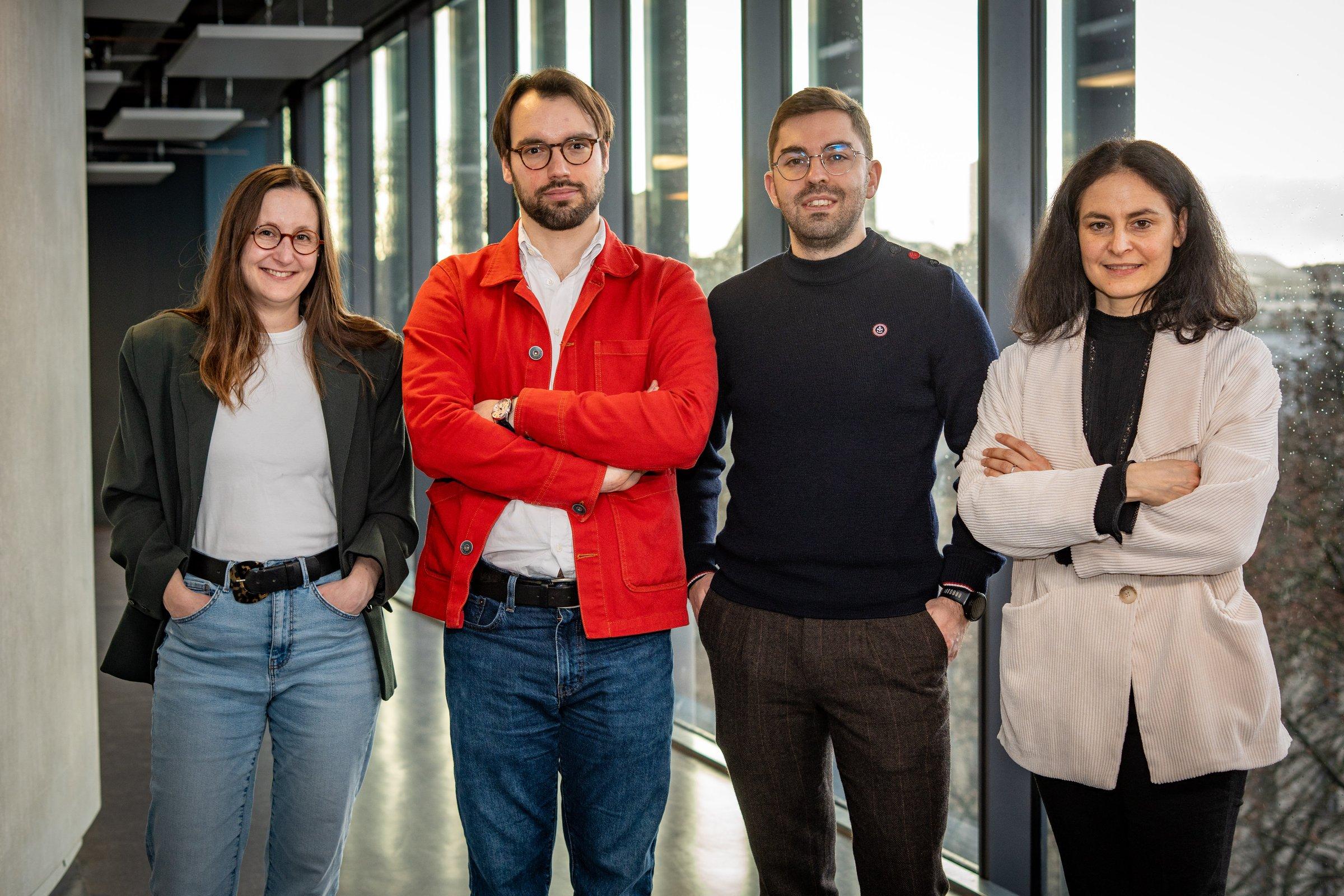
Although it has already won the 2026 i-Lab Grand Prize (supported by France 2030), Qluster was founded just a few months ago by a team of four: David Fainsin (CEO) and Ambroise Boyer (CTO), both PhD holders in quantum optics; Clarisse Thibault (COO), formerly of CNRS Innovation; and Valentina Parigi (CSO), a physicist and professor at Sorbonne University who chairs Qluster's scientific advisory board. Quantum Launchpad and Agoranov have also supported the deeptech startup since its inception.
This €4.7 million pre-seed funding round, led by Quantonation, will notably enable the company to establish its own R&D laboratory to improve the performance of its photonic technology.
Qluster also plans to significantly expand its team by recruiting experimental physicists, as well as specialists in quantum computing theory and architecture. These hires will enable the company to advance the development of its hardware components and the design of its future machine's overall architecture in parallel.
"Our approach certainly does not eliminate the scientific and technological challenges that still need to be overcome to build a reliable quantum computer. However, we believe it offers two major advantages: it builds on photonics, a field in which Europe has world-class scientific and industrial expertise, and it offers particularly promising prospects for scalability. We want to build on these strengths, with humility and pragmatism, to contribute to advances in quantum computing and, ultimately, address the concrete needs of industry," concludes David Fainsin.
By 2032, the startup plans to develop an intermediate-scale quantum computer capable of solving initial industrial problems. By 2036, it aims to significantly increase computing power with a large-scale, fault-tolerant universal quantum computer designed to tackle complex industrial challenges.
"Scalability is currently the central challenge in quantum computing. Qluster is addressing it through a continuous-variable photonic architecture that leverages nonlinear optics, opening up the prospect of millions of qubits operating at room temperature in systems that can be integrated into existing data centers. This approach, rooted in decades of research at Laboratoire Kastler Brossel, a world-renowned center for quantum optics, offers a credible path toward achieving a tangible quantum advantage. We are proud to support the team on this journey," says Ylan Tran, Investor at Quantonation.
About Quantonation
Quantonation is an international investment platform specializing in quantum technologies and fundamental physics. The firm invests in companies that translate breakthroughs in fundamental science into technologies and commercial businesses across quantum computing, sensing, communications and other emerging sectors.