


Agentic AI and the New Pace of Quantum Application Development
New work with Pasqal shows how an AI agent can translate papers, patents and natural-language requests into experiments on real neutral-atom quantum processors—including Pasqal’s machine in Saudi Arabia—and why that shifts where value is created in quantum computing.
The barrier beyond the qubits
Quantum hardware used to be the binding constraint — scarce, lab-bound, reachable only by the teams that built it. That has changed: QPUs are now stable, cloud-accessible resources. What remains is a second barrier — the specialist labor between a good idea and a running experiment: extracting a protocol, embedding it on a device, tuning pulses, modeling noise, navigating cloud infrastructure. Agentic AI is dissolving that barrier — and it changes who can create value on quantum hardware.
I came to this conviction from outside the field, through books rather than hardware.
My collection of Renaissance books was the first test. A dense, heavily accented 1544 Italian treatise defeats standard OCR, so I fine-tuned a vision-language model to read it—down to a 2.48% character-error rate, trained in about fifteen minutes for under seven dollars of cloud GPU, and released the model and dataset openly. Training and shipping a machine-learning model became a side project. That is the barrier collapsing.
Then I pushed the same idea as far from quantum computing as I could travel: the structural analysis of literary texts. In QOuLiPo, a book became a graph, the graph became a register of atoms, and a quantum processor searched for the structural backbone within the text—dozens of texts on Pasqal’s cloud QPU, roughly 3,660 hours of cloud compute for emulation, 114 of them on a real quantum processor in Sherbooke (Canada), with every job triggered from a Claude chat window.
The lesson generalizes: agents are interdisciplinary by nature. They move between literature, mathematics, software and physics, and you no longer need to be fluent in every layer of quantum science and engineering to begin programming these machines. Expertise does not disappear—it concentrates where it matters most.
Agents handle the plumbing
Our new paper with Constantin Dalyac, Alexandre Dauphin and Loïc Henriet at Pasqal, Lowering the implementation barrier of neutral-atom quantum computing with agentic workflows, tests this proposition on real hardware.
The workflow starts from a scientific paper, patent or natural-language objective. The agent extracts the protocol, adapts it to the constraints of the machine, builds the pulse sequence, runs noiseless and noise-aware emulations, submits jobs to the QPU and processes the resulting bitstrings. In other words, it handles much of the plumbing between an idea and an experiment.
Across three case studies in many-body physics and optimization, the workflow went from a published idea to a QPU campaign run overnight. A second agent screened 633 papers from the Rydberg-array literature. Of the 526 it could reliably classify, 258—49%—describe protocols already compatible with available Pasqal hardware, directly or with modest adaptation. The other half names the exact hardware capabilities worth building next: a demand-driven map for the roadmap.
A landmark physics experiment, reproduced through the cloud
One result captures the change particularly well.
In 2019, Keesling and colleagues in Mikhail Lukin’s group published a landmark experiment on quantum critical dynamics using a bespoke Rydberg-atom apparatus. Only seven years later, our agentic workflow reproduced the same physical signature on two commercial Pasqal processors: FC1 in Canada and SA1 in Saudi Arabia. I took part from my couch in Dallas—not in the laboratory, and having built neither machine.
The agent reconstructed the protocol, translated it into executable sequences, checked the hardware constraints and noise, submitted the experiments and processed the measurements. Human guidance remained essential in selecting the right observable and interpreting what the measurements meant.
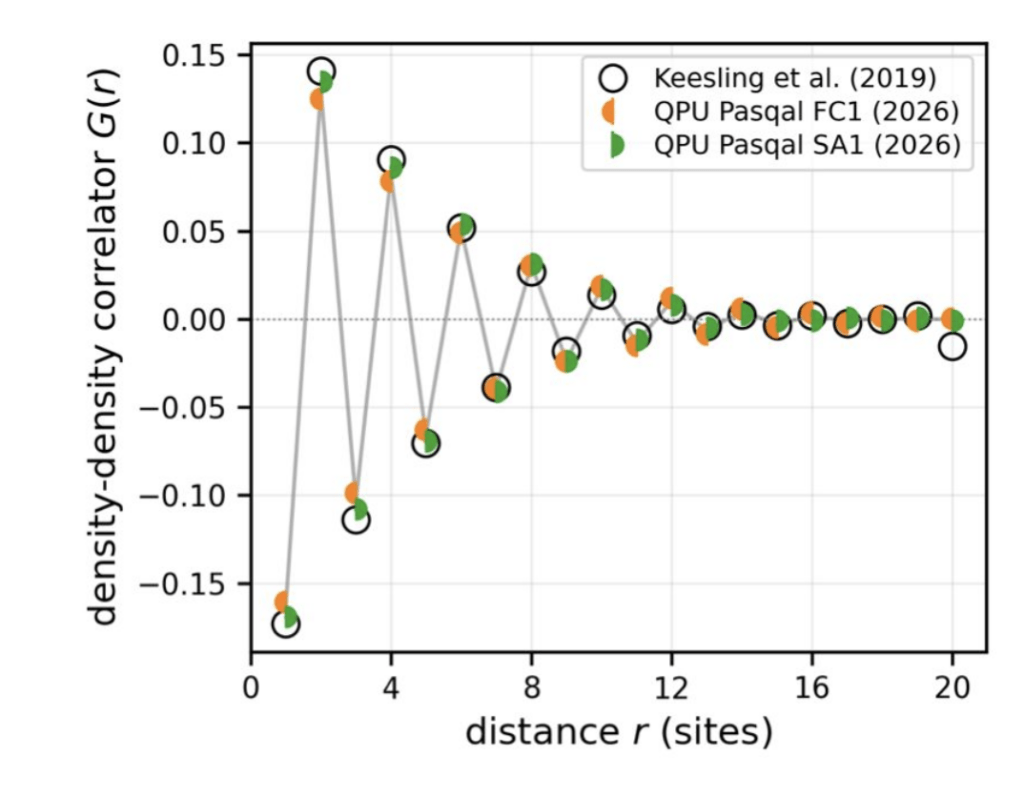
The agreement is remarkable. The original experiment gives a fitted correlation length of 3.9 sites; both Pasqal machines return 4.2 sites. This is evidence not only of the agent’s ability to reproduce an experiment, but of the consistency and growing maturity of the underlying hardware.
The SA1 measurements are especially meaningful: to our knowledge, they are the first published scientific results obtained on Pasqal’s machine in Saudi Arabia.
Where the value accrues: agent-ready hardware
An agentic workflow does not succeed through language-model capabilities alone. It rests on three foundations—and each is an investment signal for what makes a quantum platform valuable.
First, the machine must actually be available. Agents become useful when they can move beyond producing code and interact programmatically with live hardware. In practice I never had availability issues outside of planned maintenance 2 days per month.
Second, they require consistent, machine-accessible calibration and noise models. Pasqal has built exceptional foundations here but this is one field where I believe there’s room for improvement.
Third, documentation must evolve. Most technical documentation is still written for specialists navigating it by hand. Agent-ready documentation is structured, current and connected directly to executable tools—part of the machine’s interface rather than a manual beside it.
The through-line reframes the competitive question. The quantum platforms that win will be the ones that are reachable—reliable hardware, machine-readable calibration and noise, agent-ready tooling and primitives—not simply the ones with the most qubits. Access, not qubit count, is the gate.
Plumbing is not judgment
Our results also show where agents fail. In one experiment, the agent selected an inadequate observable. In another, it constructed a convincing explanation involving a hardware failure when the real problem was a mismatch between atomic coordinates and measured bitstrings. Both errors were caught only through expert scrutiny.
Agents are not autonomous scientific geniuses. They clear the plumbing, but they do not remove the need for judgment. The productive model is not a push button followed by a finished answer; it is a sustained dialogue between the researcher and the agent, with verification at every important step. That is also where durable human value—and the tooling that supports it—will sit.
From problem selection to algorithm discovery
A broader agentic stack is beginning to emerge across the Quantonation ecosystem.
Kipu Quantum’s Tinkuq begins with the user’s problem and assesses whether quantum computing is genuinely relevant. Further upstream, Iordanis Kerenidis and El-Amine Cherrat at Quantum Signals explore agents as inventors: in Quantum Agents for Algorithmic Discovery, quantum-native reinforcement-learning agents rediscover foundational algorithms and protocols—including Grover search and the Quantum Fourier Transform—without being given the known optimal circuits. Our collaboration with Pasqal addresses the next step: carrying an idea through the engineering stack and onto physical hardware.
Together, these approaches suggest an emerging chain: identify the right problems → discover algorithms → execute them on real machines
The investment implication
As agents lower the barrier, the addressable community for quantum computing expands from a few hundred specialist teams to the far larger population of scientists, engineers and analysts who have a question worth putting on a quantum machine. Value migrates toward the layers that make hardware reachable—access, calibration, verification, agent-ready tooling—and toward the applications this wider community will invent.
The greatest impact of agents may not come from automating what quantum specialists already do. It may come from opening quantum machines to people bringing questions, datasets and intuitions from entirely different disciplines. Each generation reads its world through the tools it has. Ours has just acquired a new instrument.
Christophe Jurczak
Managing Partner, Quantonation